 LinkTapes.com
Dutch and Flemish Sinterklaas
12 Sinterklaas songs and what they mean in English
If you’re putting out a shoe tonight and only know the tune, try Sinterklaas kapoentje. It’s four lines long. The child asks for something in a shoe, remembers there’s a boot to fill too, and says thank you.
Start a Sinterklaas tape
How families celebrate Sinterklaas
Sinterklaas is the Dutch and Flemish feast of Saint Nicholas. In the songs, he sails from Spain in mid-November, then rides his horse across the rooftops after dark. Before bed, children leave a shoe by the fireplace or the door and sing to him. A carrot, some hay or a bowl of water is for the horse. With luck, there’ll be a treat in the shoe by morning.
Putting out a shoe is the oldest custom of the feast. The bigger presents come on pakjesavond (“present evening”), 5 December in the Netherlands. In Flanders, children wake up to their presents on 6 December, Saint Nicholas’s feast day. Dutch clubs and schools abroad often celebrate on a weekend close to those dates.
A Dutch surprise is a present in disguise. Someone might make a cardboard horse just to hide your gift inside. It often comes with a poem to read aloud. The oldest known Sinterklaas poem dates from around 1640.
Waiting for him: songs 1–4
Long before there’s a present to open, there’s a boat to watch for. These are the songs for the crossing from Spain and the wait for Sinterklaas to reach your door.
- Zie ginds komt de stoomboot“Look, there comes the steamboat.” The horse is prancing on deck and the pennants are flying. The children watch from shore, then ask Sinterklaas to remember their house when he rides out that night. Amsterdam teacher Jan Schenkman wrote the words around 1850. His children’s book was the first to bring Sinterklaas to town by steamboat. Say it: zee khints komt duh stohm-boht.
- Wie komt er alle jaren“Who comes every year?” The song gives the children clues. Their visitor sails from Spain, and his sack is full of cookies, toys and picture books. By the time they get to shout “Sint Nicolaas!” they’ve known the answer for a while. Say it: vee komt er ah-luh yah-ruhn.
- Hij komt, hij komt“He’s coming, he’s coming, that dear, good saint.” The repeated hij komt is easy to pick up on the way to a school party, even if the rest of the Dutch is new to you. Katharina Leopold, a teacher in Groningen, set her words to Robert Schumann’s “The Happy Farmer” in 1898. Say it: hay komt, hay komt.
- Hoor de wind waait door de bomen“Hear the wind blow through the trees.” Will Sinterklaas come out on a night like this? The children remind each other that his horse is fast and knows the way in the dark. If only he knew how much they wanted to see him. Say it: hohr duh vint vight dohr duh boh-muhn.
Shoe evenings: songs 5–8
These are bedtime songs. In one, the child is still listening for hooves on the roof. In another, the visitor is already tapping at the window.
- Sinterklaas is jarig“It’s Sinterklaas’s birthday.” The child has put out hay and water for the birthday visitor’s horse and is hoping for something in the empty shoe. W. F. Oostveen wrote the words and G. C. Weeren the music in the 1920s. Say it: sin-ter-klahs is yah-rukh.
- Sinterklaas kapoentje“Sinterklaas, little capon.” Listen to how kapoentje rhymes with schoentje, “little shoe.” In Flemish you might call a cheeky child a kapoen. The song first appeared in print in 1851 and may be much older. The second verse begins Sinterklaasje bonne, bonne, bonne, which may echo the French word for “good.” Say it: sin-ter-klahs kah-poon-tyuh.
Dutch
Sinterklaas kapoentje, Gooi wat in mijn schoentje, Gooi wat in mijn laarsje, Dank u, Sinterklaasje.
English
Sinterklaas, little capon, toss something in my little shoe, toss something in my little boot. Thank you, dear Sinterklaas.
First printed in De Navorscher in 1851. - Zachtjes gaan de paardenvoetjes“Softly go the horse’s hooves.” Trippel trappel goes the gray horse, carrying Sinterklaas over the roofs in the moonlight. The horse could go on all night. The child listening for those little hoofbeats has to go to bed. Say it: zahkh-tyuhs khahn duh pahr-duh-voo-tyuhs.
- Hoor wie klopt daar, kinderen“Listen, children, who’s knocking?” There’s a soft tap at the window. Could it be someone who’s lost their way? Then the children recognize Sint Nicolaas. He’s come to scatter sweets in a corner of the room. Say it: hohr vee klopt dahr, kin-duh-ruhn.
Presents and goodbye: songs 9–12
Save these for the party or for opening presents at home, whether that’s the evening of 5 December or the following morning. There’s one last song for when Sinterklaas has to go.
- Zie de maan schijnt door de bomen“See the moon shining through the trees.” For a moment the children hush. It’s the night they’ve waited for, and the old verse leaves them wondering who’ll get a piece of cake and who’ll get the rod. Jan Pieter Heije wrote the words, which appear in his 1861 collection of children’s songs. J. J. Viotta wrote the music. Say it: zee duh mahn skhaynt dohr duh boh-muhn.
Dutch
Zie, de maan schijnt door de boomen, Makkers! staakt uw wild geraas; ’t Heerlijk avendje is gekomen, ’t Avendje van Sint-Niclaas! Van verwachting klopt ons hart, Wie de koek krijgt, wie de gard!
English
Look, the moon shines through the trees. Quiet down, friends! At last this lovely evening is here, the evening of Saint Nicholas! Our hearts race as we wonder who’ll get the cake and who’ll get the rod.
The Dutch verse keeps Heije’s 1861 spelling. If you learned Vol verwachting at the start of line five, that’s how most people sing it today. - De zak van Sinterklaas“Sinterklaas’s sack.” There’s marzipan for young and old, and the biggest parcel is right at the bottom. Then comes the rather awkward question of whether you’ve been good. Say it: duh zahk vahn sin-ter-klahs.
- O, kom er eens kijken“Oh, come and have a look.” You can hear the child calling everyone over to see what’s in the shoe, right down to the last pastry letter. Katharina Leopold called the song Zes december (6 December) in 1898. She wrote a verse for girls and another for boys, both sung to a tune by H. G. Nägeli. Say it: oh, kom er ayns kay-kuhn.
Dutch
O, kom eens kijken, Wat ik in mijn schoentje vind, Alles gekregen Van den besten Sint! Een pop met vlechtjes in het haar, Een snoezig jurkje, kant en klaar, Drie kaatseballen in een net, Een letter van banket.
English
Oh, come and have a look at what I’ve found in my little shoe! It all came from the best Sint in the world! A doll with braids in her hair, a sweet little dress, ready to wear, three balls in a net, a letter made of pastry.
The girls’ verse from Leopold’s 1898 songbook Sint Nikolaas. - Dag Sinterklaasje“Goodbye, dear Sinterklaas.” The children sing this as he leaves the party. If all you can remember is dag, you can still wave him off in Dutch. Say it: dahkh sin-ter-klah-shuh.
You might remember a line differently from your child. Some verses have changed over the years. If you’re choosing a recording for a school or club party, ask which version the children know.
Sinterklaas words, explained
In the “Say it” column, put the stress on the bold syllable. The spellings give you a rough guide to the sounds. Try the ch in Scottish loch for kh, and the vowel in moon for oo.
| Say it | Meaning | |
|---|---|---|
| Sinterklaas, Sint | sin-ter-klahs, sint | Saint Nicholas. Sint is the short form. |
| stoomboot | stohm-boht | A steamboat, like the one that brings Sinterklaas from Spain. |
| schoen zetten | skhoon zet-tuhn | To put your shoe out in the evening for Sinterklaas. |
| kapoentje | kah-poon-tyuh | Literally “little capon,” a kind of rooster. In Flemish, you might also call a mischievous child a kapoen. |
| pakjesavond | pahk-yuhs-ah-vont | “Present evening,” when families in the Netherlands open gifts and read poems aloud on 5 December. |
| strooigoed | stroy-khoot | Treats tossed by the handful, usually the little spiced cookies called kruidnoten. |
| pepernoten | pay-per-noh-tuhn | Bite-sized pieces of spiced cake, softer and larger than kruidnoten. |
| kruidnoten | krowt-noh-tuhn | Small, crunchy spiced cookies. You’ll often hear people call them pepernoten too. |
| banketletter | bahn-ket-let-ter | A pastry shaped like a letter, often an S. These have been part of the feast since at least the 19th century. |
| mijter | may-ter | A miter, the tall bishop’s hat Sinterklaas wears. |
| surprise | sur-pree-zuh | A gift in a playful disguise, often homemade. A poem may be tucked in with it. |
| gedicht | khuh-dikht | A poem. At Sinterklaas, it’s often a rhyme written for the person opening a gift. |
Singing together when you’re learning Dutch
If your child knows more Dutch than you do, ask them to teach you Sinterklaas kapoentje. The first verse is just four lines. Dag Sinterklaasje is another easy one to learn by ear. To find the lyrics, search for the Dutch title followed by tekst. The one-page song sheet (PDF) gives you all twelve titles, their meanings and how to say them. To learn the tunes by ear, play the Sinterklaas songs tape: a children’s choir sings all twelve, each with a short note in English.
Leave room for a favorite in your family’s other language, too. And if the grandparents live far away, ask which song they remember singing as children. Opa and Oma in Amsterdam can send it before bed and the grandchildren in Sydney can listen over breakfast.
For more songs in Dutch, see the guides to pakjesavond in the Netherlands and 6 December in Flanders.
Let the whole family add a song
Try asking the family group chat, “Which song did you sing when you put your shoe out?” Send a tape link with the question so everyone can add the recording they remember.
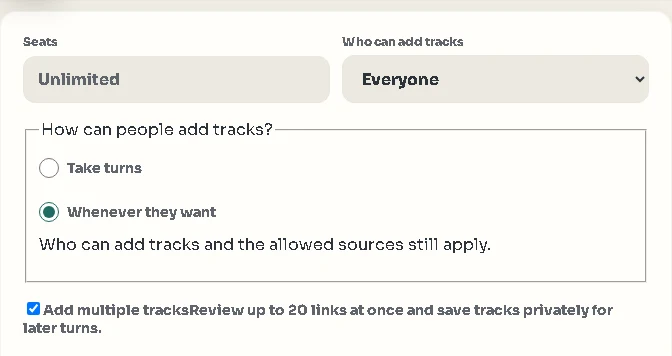
- Create the tapeStart a tape on the Link Tapes homepage and open Tweak the rules. Under Who can add tracks, choose Everyone. Select Whenever they want and turn on Add multiple tracks.
- Share the linkRelatives can open the link and join with just a name. They can add a song from YouTube, Spotify, Deezer or SoundCloud and leave a note about why they chose it. Add multiple tracks can check up to 20 individual song links at once.
- Pick your versionsIf two people pick the same song, listen to both versions. One might be the recording the children know from school. Keep your favorites and remove any duplicates. There’s more on managing the list in the event song-request guide.
Try the songs on your speaker
Connect one phone or laptop to the speaker and play the songs you’re counting on before anyone arrives. Check the volume and keep the charger handy. Everyone else can use their phone to add requests while you handle playback and skip songs as needed.
A Link Tapes tape needs an internet connection. YouTube tracks play when the video is available and allows embedding. Spotify and Deezer can play previews unless the browser playing them is signed in to a Premium account for that service. Keep a backup for the songs you can’t do without.
Questions people ask
When is Sinterklaas celebrated?
Dutch families usually open presents on the evening of 5 December. In Flanders, children find theirs on the morning of 6 December, Saint Nicholas’s feast day. Dutch schools and clubs abroad often choose a nearby weekend for their party.
What does pakjesavond mean?
It means “present evening.” In the Netherlands, that’s the evening of 5 December, when families gather to open gifts and read aloud the poems that come with them.
What does Sinterklaas kapoentje mean?
The literal translation is “Sinterklaas, little capon.” A capon is a type of rooster. In Flemish, kapoen can also be a fond nickname for a cheeky child. The child in the song asks for something in a shoe, then a boot, and finishes with a thank-you.
Is Sinterklaas the same as Santa Claus?
No. Both traditions have roots in Saint Nicholas. In the Netherlands and Flanders, Sinterklaas has his own feast in early December, with songs, shoes and presents. Santa Claus belongs to Christmas.
Can grandparents add a song from another country?
Yes. Send them the tape link. All they need to do is enter a name and paste a song link from YouTube, Spotify, Deezer or SoundCloud. They can do it whenever they’re awake, without an account or an app.
Do all Sinterklaas songs play in full?
Not always. A YouTube video has to be available and allow embedding. Spotify and Deezer play previews unless the browser playing the tape is signed in to a Premium account for that service. Try your chosen recording on the phone or laptop you’ll use at the party.
Start your Sinterklaas tape
Send the family a link and ask for one song each. What would they like the children to hear this year?